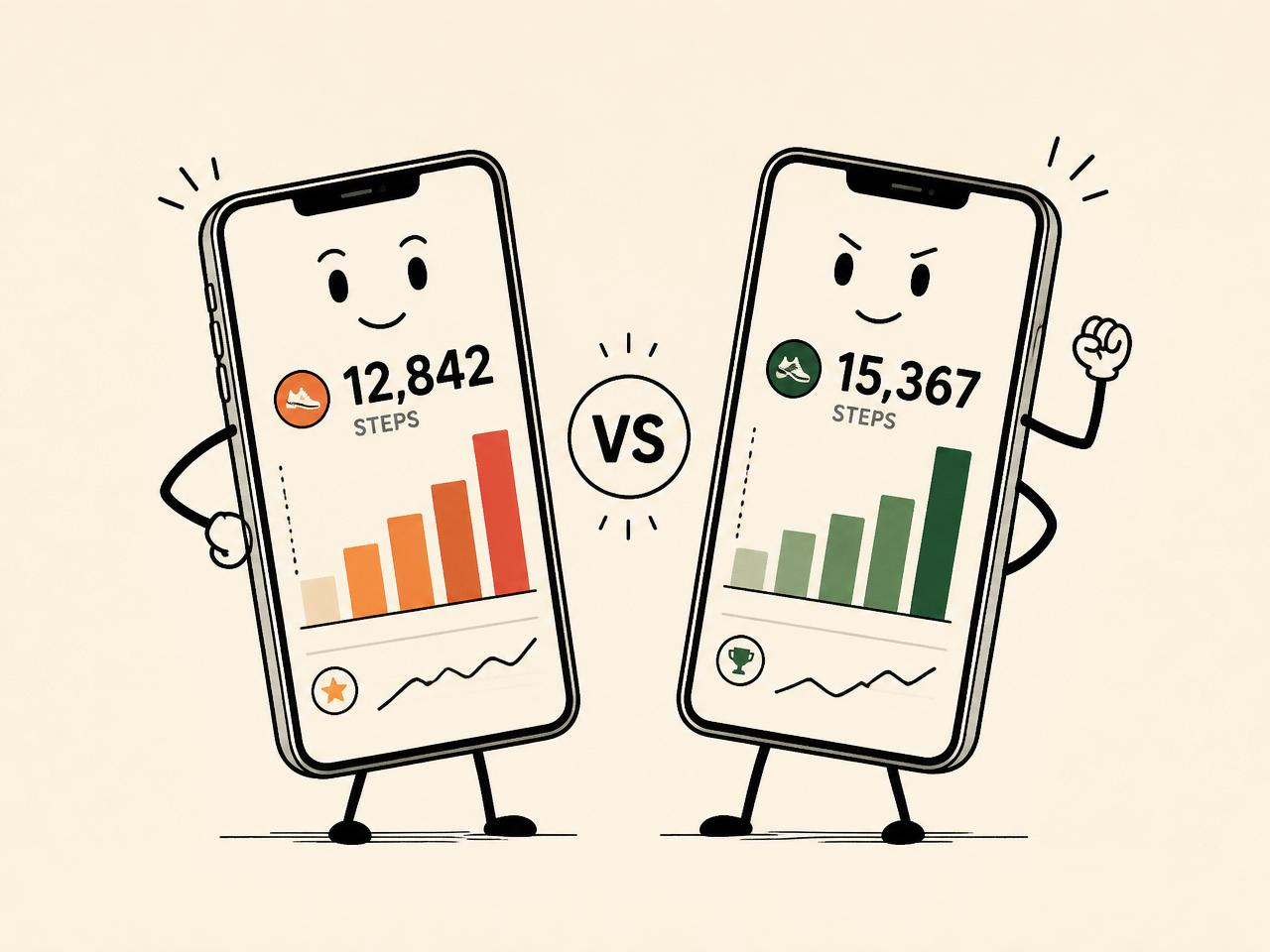
I designed a social competition app that turns phone-tracked behavior into head-to-head challenges between friends.
- Social Product Design
- Digital Wellbeing
- HealthKit
- Screen Time APIs
- iOS
- Product
- Challenge
- Role
- Product Designer & iOS Engineer
- Duration
- Ongoing
- Platform
- iOS
- Team
- Independent project
My responsibilities
- Product strategy
- Market and behavioral research
- Competitive analysis
- Interaction design
- Prototype implementation
- Iterative refinement
About the product
Challenge is a social competition app that uses automatically digitally tracked metrics to turn everyday habits into games between friends. Users create time-bound challenges around goals such as walking more steps or spending less time on screens, and their phones track the results throughout the competition.
Alongside participating in challenges, users can follow activity across their social network, react to and comment on competitions, predict winners, and compare personal, peer, and head-to-head statistics. By combining habit tracking with the engagement and accountability of a social network, Challenge makes personal goals more motivating, measurable, and fun.
Explore the prototype
View interactive prototypeKey observations
Strong demand for products that improve digital and physical habits
The continued popularity of fitness tracking, digital wellbeing, and habit-building applications suggests that users actively seek tools to better understand and improve their daily behavior. Products such as Apple Health, Apple Screen Time, Strava, Opal, and One Sec have attracted millions of users by helping people track metrics like physical activity, exercise, and device usage. Phone-tracked lifestyle metrics already have inherent value to users, creating an opportunity to explore more engaging ways of motivating behavior change.
~90% more
A study in JAMA Internal Medicine found participants placed in social comparison groups attended the gym approximately 90% more frequently than those receiving individual support alone.
+23% steps
A large-scale analysis of more than 2,500 walking competitions found participants increased their average daily step count by ~23% during competitive events.
People are naturally curious about the everyday lives of their friends
Many of today's most successful social products are built around sharing surprisingly ordinary aspects of daily life. Rather than focusing on highly curated content, applications such as BeReal, Strava, Apple Fitness Sharing, and even Venmo's public activity feed demonstrate that users enjoy observing the routines, achievements, and habits of people they know. This suggested that challenge results, activity updates, and friendly rivalries could form compelling social content, transforming otherwise private behavioral data into interactions users actively choose to share.
Goals
After evaluating the problem space and existing products, I set out to design the application with the following goals in mind:
- 01
Motivate users to improve measurable lifestyle habits by leveraging friendly competition rather than relying solely on personal goals or passive analytics.
- 02
Create a social experience that is engaging, interactive, and encourages repeat use, users can participate not only by competing but also by reacting to, commenting on, and following challenges across their network.
- 03
Ground the experience in objective, trackable data by presenting both live challenge progress and long-term player statistics.
- 04
Minimize friction in configuring challenges, users can create, accept, and participate in just a few interactions while keeping rules and progress easy to understand.
Exploring solutions
Before finalizing the product, I explored three different approaches to both the user experience and monetization.
Option 1
Real-money wagering
The initial concept centered around real-money bets between friends. While this created strong incentives, it introduced significant legal, regulatory, and trust challenges.
Why it wasn't chosen: the complexity outweighed the benefits and conflicted with the goal of a lightweight social product.
Option 2
Ads & premium memberships
A traditional model using advertisements and premium subscriptions was considered. However, restricting features or interrupting the experience would reduce engagement during the most important stage of user growth.
Why it wasn't chosen: early success depended on maximizing participation, not short-term revenue.
Final direction
Cosmetic in-app economy
The final design keeps all core functionality free while monetizing through optional cosmetic purchases. Users can earn or purchase in-app currency to unlock profile customizations, badges, avatars, and stickers.
Proposed design
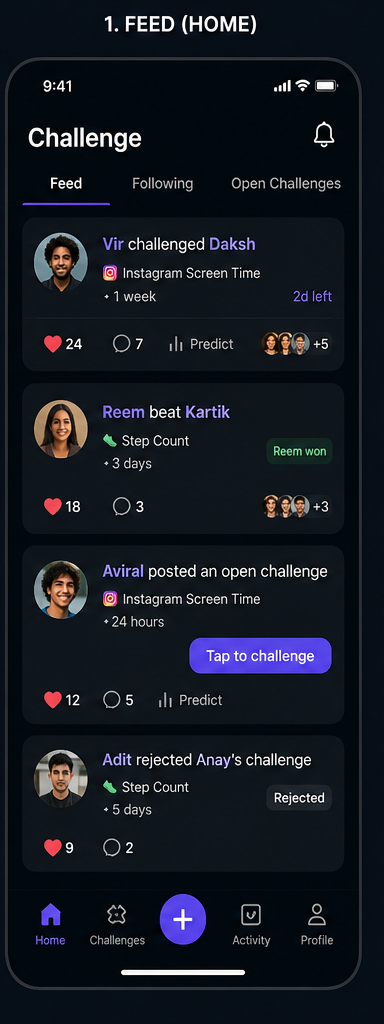
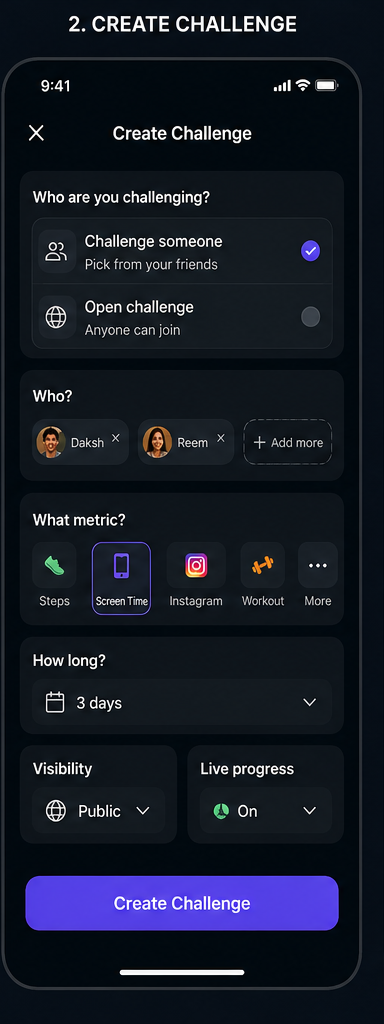
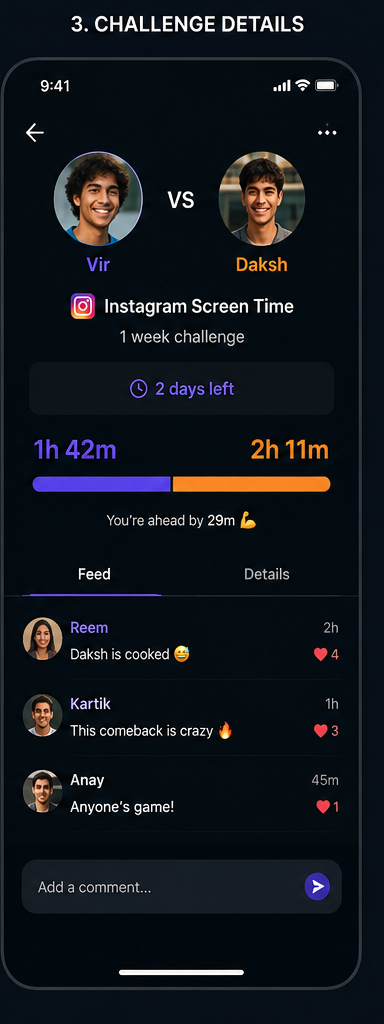
The final design centered around creating a fast, social, and competitive experience, built across four core screens.
01
Social feed first
The app opens to a live feed of challenge activity rather than a personal dashboard. Invitations, victories, predictions, and comments create continuous opportunities for interaction, even when users are not actively competing.
02
Frictionless challenge creation
Users can customize participants, metrics, duration, visibility, and optional stakes, while the flow stays short enough to complete in just a few taps.
03
Objective, live competition
Automatically tracked phone metrics make every challenge transparent and measurable. A live scoreboard and running comment thread keep users invested throughout the competition.
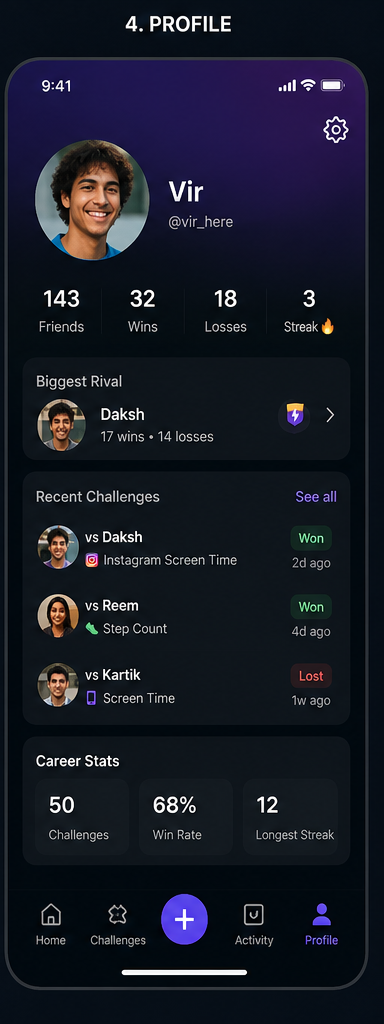
04
Statistics as identity
Profiles emphasize competitive history over follower counts win rate, streaks, biggest rival, and career stats become the primary social signal.
Projected solution impact
Based on market research and existing consumer behavior, the proposed design has the potential to appeal to users already interested in fitness, habit tracking, and social networking.
$6B by 2034
The global habit tracking app market is projected to exceed $6 billion by 2034, highlighting growing demand for tools that encourage healthier habits.
+23% daily activity
Studies of fitness competitions found participants increased their daily activity by an average of 23%, demonstrating the effectiveness of friendly competition.
Motivation ↑
Research shows that social comparison and community features improve both motivation and long-term engagement in fitness applications.
Validated pattern
The success of platforms such as Strava and BeReal validates user interest in sharing everyday activities through lightweight social experiences.
Reflections
What went well
The project successfully combined habit tracking with social interaction into a single experience. Prioritizing competition over analytics helped differentiate the product from traditional fitness and productivity apps, while the simplified user flow kept the experience intuitive.
Potential next steps
Future iterations could expand the platform through:
- Seasonal or themed challenges to encourage recurring participation.
- Sponsored events in partnership with fitness brands or organizations.
- Integrations with devices and services such as WHOOP, Oura, Goodreads, and other apps to support additional metrics like sleep, recovery, reading, and meditation.
Key takeaway
This project reinforced that building an engaging product should come before optimizing monetization. For an early-stage social app, reducing friction and encouraging participation are more valuable than maximizing short-term revenue. A product that users genuinely enjoy creates far more opportunities for sustainable monetization in the long run.
Explore the prototype
View interactive prototypeWalk through the core flow: feed, challenge creation, live competition, and profile.
Up next
FPL Assistant Manager, AI personalization
Designing an AI-powered assistant that personalizes Fantasy Premier League without taking control away from managers.