I designed an AI-powered Assistant Manager to personalize the Fantasy Premier League experience for over 12 million players.
- AI
- Personalization
- Conversational UI
- Product Strategy
- Monetization
- Role
- Product Designer
- Project type
- Existing Product Iteration Design
- Team
- Individual Project
- Platform
- Web & Mobile
- Duration
- 4 Weeks
About the product
Fantasy Premier League requires managers to make weekly decisions based on player form, fixtures, injuries, transfers, expected minutes, and chip strategy. While all of this information is publicly available, interpreting it requires considerable research and experience.
I designed Assistant Manager, an optional premium feature that provides personalized recommendations based on both real-world football data and each user's individual management style. Rather than making decisions for users, the feature explains its reasoning and allows managers to remain in complete control of their squads.
Key observations
There is already demand for expert advice
Millions of Fantasy Premier League managers consume content from YouTube creators, podcasts, Reddit, and statistics platforms before making weekly decisions. This demonstrates that players actively seek guidance, but currently need to gather and interpret information from multiple external sources before finalizing their team.
12M+ players
Fantasy Premier League has over 12 million active managers making weekly decisions across a 38-gameweek season.
No two styles alike
Some managers minimize risk with consistent performers, while others chase high-risk differentials, advice platforms typically give everyone the same answer.
Managers have different philosophies
There is no universally "correct" way to play Fantasy Premier League. Some managers prioritize minimizing risk with consistent performers, while others chase high-risk differential picks. Some remain loyal to players from the club they support, while others focus purely on maximizing points. Existing advice platforms typically provide identical recommendations to everyone, overlooking these individual preferences.
The experience lacks personalization
Despite the strategic nature of Fantasy Premier League, every manager interacts with essentially the same product experience. Aside from differences in squad composition, the platform offers little adaptation to individual playing styles. This creates an opportunity for AI to deliver recommendations that reflect each user's unique management philosophy without changing the core mechanics of the game.
Goals
After evaluating the existing experience, I established the following design goals:
- 01
Reduce the amount of research required before each gameweek.
- 02
Deliver recommendations tailored to each manager's preferred playing style.
- 03
Explain every recommendation transparently rather than acting as a "black box."
- 04
Integrate naturally into the existing FPL interface without disrupting familiar workflows.
Exploring solutions
Option 1
Static weekly advice
A weekly report containing generic recommendations for transfers, captain selections, and lineup changes based solely on current player data.
Why it wasn't chosen: easy to implement but gives every user the same answer, ignoring squad composition, chips, budgets, and playing style, limiting its value over existing creators.
Option 2
Conversational AI only
A chatbot that lets managers ask questions about players, fixtures, transfers, and strategy on demand.
Why it wasn't chosen: flexible, but relies on users knowing what to ask. Less experienced managers don't know which decisions deserve attention, the feature becomes reactive rather than proactively guiding better decisions.
Final direction
Proactive report + conversational follow-up
A personalized weekly report that surfaces the decisions worth attention, paired with a conversational assistant for follow-up, every recommendation shaped by the manager's stated playing style and paired with a confidence rating to communicate uncertainty transparently.
Proposed design
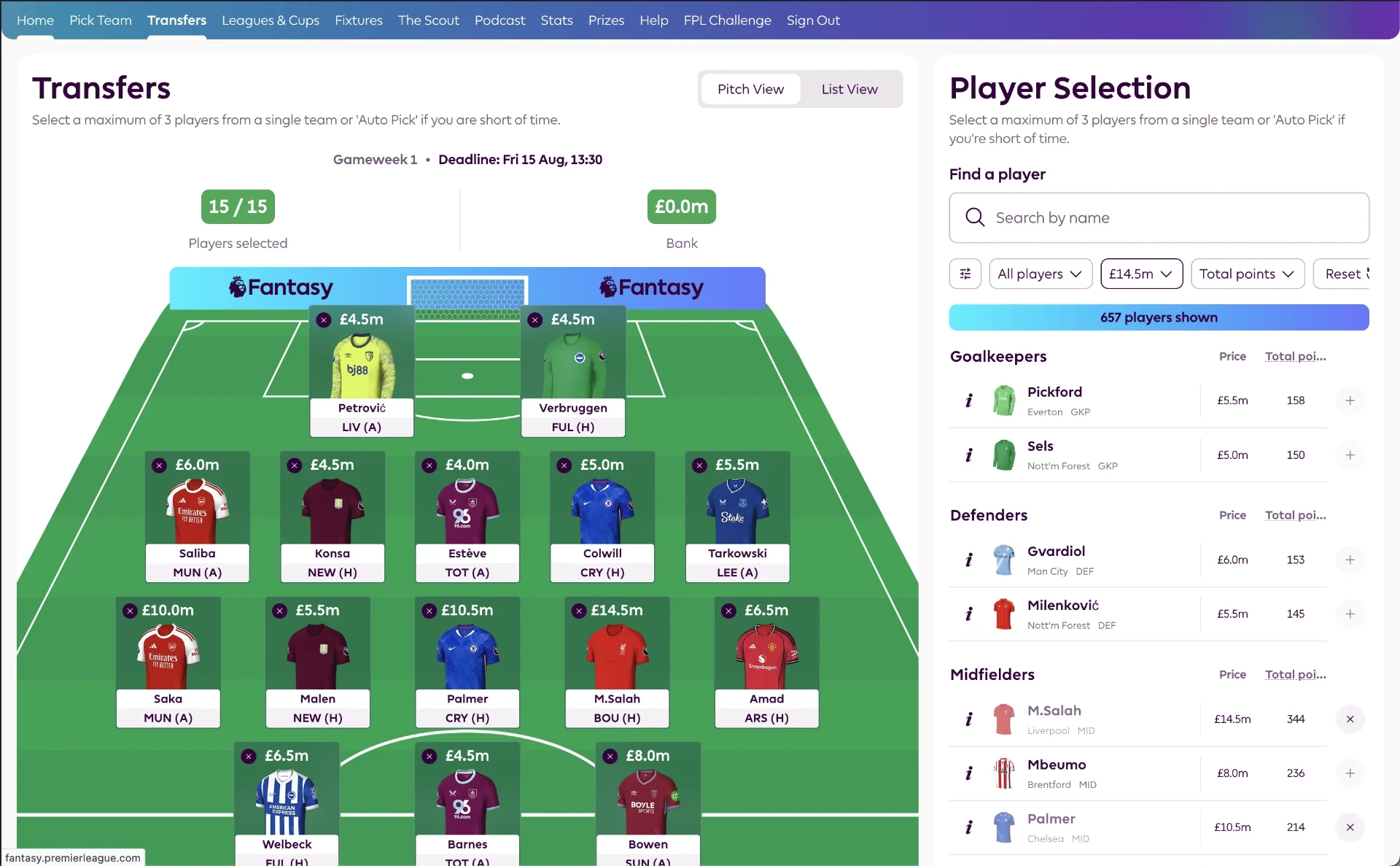
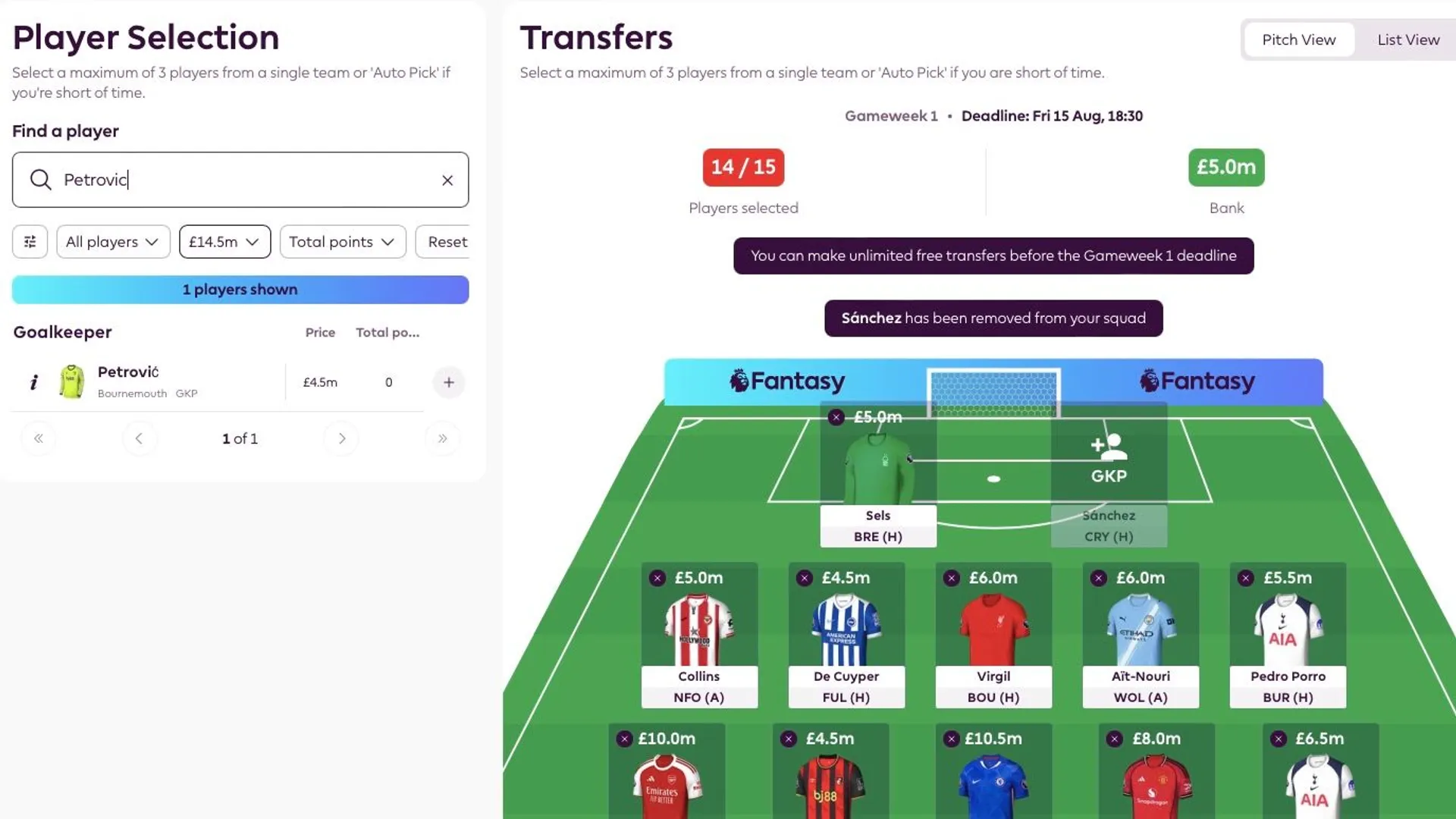
The Assistant Manager lives inside the existing Team Management page that FPL managers already use to pick a squad, make transfers, and set captains. Only onboarding gets its own screen. The weekly report and chatbot are docked into the page where the Player Selection panel normally sits, so nothing about the familiar workflow moves.
01
Meet your Assistant Manager
Onboarding is the one part of the feature that gets its own screen, shown once during team creation for users who opt into the premium tier. Instead of fixed preferences, every question is answered on a sliding scale, so the system captures each manager's playing style rather than a checklist. These preferences are remembered throughout the season and shape every recommendation the assistant makes afterward.
02
Weekly Assistant Manager report
Before every gameweek, users receive a personalized report summarizing what went well and wrong the previous week, plus recommended transfers, captain and vice-captain, starting XI and bench order, chip strategy, and projected points.
Every recommendation follows the same structure: Recommendation → Justification → Confidence rating. Rather than just naming a player, the Assistant Manager explains why, referencing fixture difficulty, form, injuries, expected minutes, and the user's stated preferences.
03
Conversational assistant
Alongside the weekly report, managers can ask follow-up questions through a natural-language chat interface, "Why captain Haaland over Saka?", "Should I take a four-point hit?", "Why are you saving my Wildcard?" Because the assistant remembers each user's philosophy, responses stay personalized rather than simply optimizing projected points.
04
Explainability & trust
Football is inherently unpredictable, so the Assistant Manager presents every recommendation with an associated confidence rating instead of implying certainty. This communicates uncertainty transparently while helping users understand which recommendations are strongly supported by the available data and which involve greater risk.
Monetization
Assistant Manager is offered as an optional premium feature when users create their team at the start of each season.
Managers who subscribe gain access for the entire season, creating an annual subscription model that aligns naturally with FPL's seasonal gameplay. Teams using Assistant Manager display a small badge beside their squad, providing transparency while preserving competitive fairness.
Projected solution impact
Based on existing user behavior and market trends, the proposed feature has the potential to deliver value for both managers and Fantasy Premier League.
Less research
Reduces the research burden for casual managers while keeping experienced players in complete control.
Personalized
Creates a personalized experience within an otherwise standardized game.
Season-long engagement
Encourages greater season-long engagement through weekly AI reports and ongoing conversations.
Recurring revenue
Introduces a recurring seasonal revenue stream without restricting core gameplay, and lays a scalable foundation for future AI-powered features across FPL.
Reflections
What went well
The project successfully identified a meaningful opportunity to apply AI without fundamentally changing the existing product. By focusing on personalization rather than automation, the Assistant Manager complements the traditional FPL experience instead of replacing it.
Potential next steps
While this concept focuses on delivering weekly recommendations, future iterations could make the Assistant Manager even more adaptive.
- Learn from user responses to previous recommendations, refining future advice based on accepted or rejected suggestions.
- Incorporate live team news and late injury updates before each gameweek deadline.
- Grow increasingly personalized as it learns each manager's decision-making habits throughout the season.
Each of these stays tightly aligned with the core idea: an AI that becomes a better assistant by learning how you like to manage your team.
Key takeaway
One of the biggest lessons from this project was that AI is most valuable when it helps users make better decisions, not when it makes decisions for them. Rather than optimizing purely for projected points, the Assistant Manager adapts to each user's individual management philosophy, creating a more personal and engaging Fantasy Premier League experience.
Up next
Avataar, mobile 3D capture
Redesigning a mobile 3D capture workflow from six minutes to under 150 seconds.